
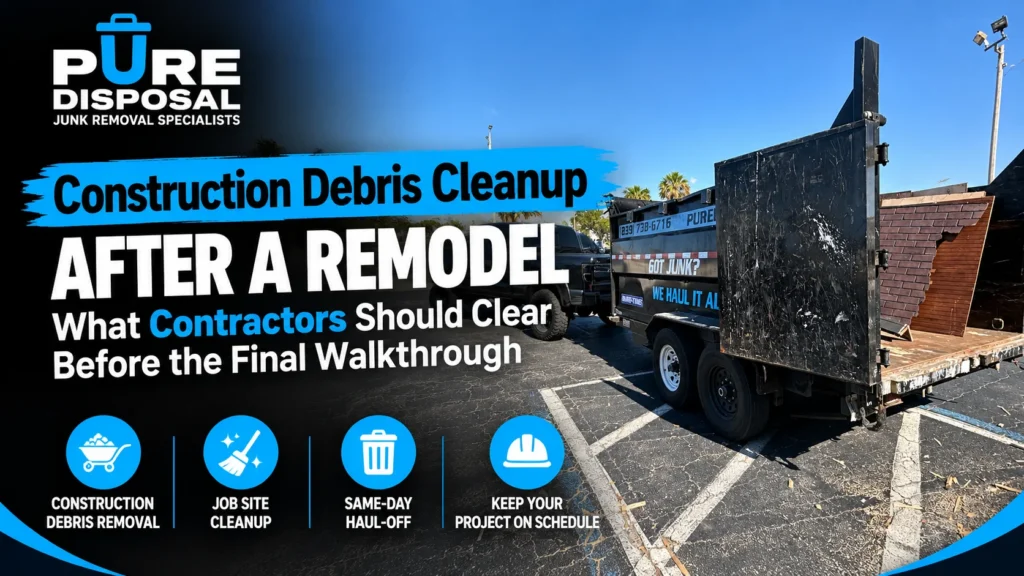
The last trade walks off on a Thursday. The final walkthrough is Monday morning. Floors are down, trim is caulked, paint has cured, and the kitchen genuinely looks like the renderings the homeowner approved six weeks ago.
But stand in that kitchen on Friday and the room is still visibly a jobsite. Drywall offcuts behind the new island. The old vanity leaning against the garage wall. Lumber scraps on the lanai. Three bags of appliance packaging stacked by the back door. Painter’s plastic balled up in the second bedroom. A toilet from the demo wrapped in plastic by the side gate. The electrician’s wire clippings on the primary bath floor.
That stretch between “the trades are done” and “the house is ready for the client” is where most Estero remodels quietly lose two or three days of schedule. The construction work finished on time. The handoff didn’t, because the debris piece never got scoped. If you’re searching for construction debris removal across Estero right now, you are probably living exactly that gap, and the Monday walkthrough is going to be awkward unless something gets handled by Saturday afternoon.
This piece walks through what has to physically leave the property before a client walks in, how post-remodel cleanup actually runs in three phases, where contractors most often lose the schedule, the OSHA rules that quietly apply to almost every tile demo and stone counter install, and how same-day haul-off keeps a tight punch-list honest.
The three phases of post-remodel cleanup, and why the order matters
Post-construction cleanup is almost never one job. On any Estero remodel bigger than a powder room, it is three distinct phases that run in a specific order. Skipping or combining them is the single most common reason a project ends up over schedule or over budget at the end.
Phase 1 — Rough clean (the debris haul-off)
Phase 1 is the heavy lifting. It is the physical removal of everything that is no longer part of the finished building — demo material, construction scrap, packaging, protective film, the whole stack of stuff the finish trades generated and no one has moved yet. On a kitchen remodel, this is when the old cabinets, the demo’d island framing, the old range and hood, the sink and faucet, the backsplash tile, and the pile of appliance packaging all leave the property in a single visit.
This phase is the one Pure Disposal LLC handles. It is also the phase where contractors most often undercount volume. A kitchen remodel in Estero typically generates one to two full trailer loads once you count the demo’d cabinetry, the old countertop, the old appliances, and every piece of cardboard and foam that showed up with the new ones. A whole-house project can produce three to five trailers if nobody has been running interim hauls as the trades finish.
Phase 1 has to run before anything else. A detail cleaning crew that arrives to a kitchen full of drywall scraps and painter’s plastic will either work around the pile — slowly, at full billable rate — or walk back out. Either way, you have paid for an hour and the surface work has not started.
Phase 2 — Detail clean (the specialized surface work)
Once the pile is gone, Phase 2 is a different crew with different equipment doing fundamentally different work. Fine construction dust is not the same as household dust. Drywall powder, concrete particulate, grout haze, and silica from tile demo are all extremely fine, which means a standard shop vacuum does not capture them — it just blows them back into the room through its own exhaust. Drywall dust in particular will destroy the motor of a non-HEPA vacuum in a matter of hours.
Phase 2 is HEPA-filtered vacuuming of ceilings, light fixtures, vents, cabinet tops, trim, and baseboards. It is wipe-downs of every finished surface. It is sticker and label removal from new windows, new appliances, and new fixtures. It is scraping caulk, paint overspray, and adhesive off glass. It is grout haze removal from new tile. It is interior window washing. It is floor machine scrubbing calibrated to the specific flooring material. On a full-kitchen remodel, this phase usually takes a full day with a trained crew.
The detail work matters because this is what the client actually sees. A beautifully built kitchen with construction dust on the top of the cabinets reads as unfinished, even to a homeowner who could not tell you what the gap between finished and unfinished actually is.
Phase 3 — Touch-up clean (the piece most contractors try to skip)
Phase 3 runs 24 to 48 hours after Phase 2, and the gap is deliberate. Fine construction particulate stays airborne for a full day after Phase 2 is complete. Every time the HVAC cycles, the system pulls that remaining dust out of corners, ceiling tracks, and the top of cabinets. Foot traffic kicks it up again. Over the next 48 hours it gradually settles back down onto surfaces that were spotless when the detail crew left.
Phase 3 catches that settled dust before the client sees it. It also catches whatever smudges got added during late punch-list work, the appliance delivery, or the homeowner’s pre-walkthrough visit. It is the shortest phase — usually just a few hours on a residential remodel — but it is the one that most often costs retention money at the walkthrough. A client who sees a visible dust line on a window sill or a smear on the new refrigerator door forms a different impression of the entire project than a client who sees a spotless finished space.
Most contractors try to collapse Phase 3 into Phase 2 to save a visit. The dust does not cooperate. It settles on its own schedule.
Why remodel projects in Estero face a unique set of pressures
Estero is not just another SWFL market when it comes to end-of-project cleanup. A combination of homeowner profile, HOA logistics, and seasonal weather pushes schedules in ways that contractors in other markets do not have to plan around.
A significant share of Estero remodels happen in homes that are vacant for part of the year. The owner is in Michigan, Pennsylvania, or Ontario, and the project is being managed remotely. The walkthrough date is tied to a flight, and the flight is not flexible. If the Phase 1 haul-off slips to Monday, there is no slack in the schedule to recover.
A high percentage of Estero projects also run inside gated communities and condo buildings — Pelican Sound, The Vines at Estero, West Bay Club, Shadow Wood, Grandezza, Rapallo, Verandah, Fountain Lakes. Each one has its own rules: approved contractor hours, loading dock reservations, elevator schedules, certificate-of-insurance requirements, and HOA sign-off on anything placed on a driveway for more than a few hours. A project that generates debris on a Thursday afternoon can lose two days to a building’s Friday-only loading dock window if nobody planned for it. Dumpster rental in Estero is also constrained by these rules — many of the gated communities simply do not allow roll-off dumpsters on driveways for the duration of a remodel.
Hurricane season adds another layer of pressure, especially from June through October. Debris cannot be left on a driveway through a storm watch. Dumpsters have to leave the property through a warning. If the weather page gets busy, the window for a Phase 1 haul-off compresses dramatically, and the trucks that normally run on same-day schedules are suddenly booked out for a week.
The practical consequence: Estero remodels need their Phase 1 piece scoped and scheduled earlier than contractors in less-constrained markets are used to planning. One mid-project haul to clear demo waste, one end-of-project haul to clear finish-trade scrap, and the walkthrough date stops being a source of anxiety.
What has to leave the site before a walkthrough
The full debris inventory on a remodel is almost always bigger than the GC remembers. Walking through it category by category usually reveals the scale.
Kitchen remodel
A full kitchen remodel generates several distinct material streams. The demo’d cabinetry and cabinet backing is usually the largest single pile by volume. The old countertop — whether laminate, quartz, granite, or marble — is the heaviest. Stone counters alone can weigh 400 to 600 pounds for a typical kitchen, and they need a two-person crew with the right straps and dollies to move safely without damaging new floors.
Then there is the fixtures stream: the old sink, faucet, garbage disposal, and p-trap assembly, plus any pendant light boxes and old lighting that got swapped. The appliances stream is its own problem — the old refrigerator, dishwasher, range, hood, and microwave all have to go, and the refrigerator and any built-in icemaker contain refrigerant that has to be reclaimed before disposal. These are not units a general dumpster will accept, and they require specific handling through a hauler who knows the right facility.
Finally, there is the packaging stream, which contractors routinely underestimate. A new kitchen arrives in a mountain of cardboard — cabinet boxes, appliance boxes, countertop crating, plumbing packaging, hood packaging, protective foam. By the end of install week, that packaging alone is often a full truckload.
Everything above is standard Phase 1 scope on an Estero kitchen remodel. If you want this routed cleanly, appliance removal in Estero and the refrigerant-reclaim piece both run on the same haul.
Bathroom remodel
A primary-bath or guest-bath remodel generates less total volume than a kitchen but more types of material. The old vanity, mirror, and medicine cabinet come out first, usually in Phase 1 of demo. The old toilet gets wrapped and set aside. The old tub or shower pan may need to be cut in half for removal, especially on fiberglass units in older Estero homes with tighter doorways.
The tile stream is substantial. Demo’d wall tile, floor tile, backer board, and the mortar bed from an older shower add up to several hundred pounds of weight in a surprisingly small footprint. Old shower doors need to be crated or wrapped for safe transport — glass that cracks in the trailer is a liability. Plumbing fixtures, valves, towel bars, grab bars, and exhaust fan housings all come out together.
HVAC or AC replacement
An AC unit swap or full HVAC replacement is its own debris event. The old condenser contains refrigerant and cannot be disposed of in a standard dumpster — the refrigerant has to be reclaimed by a licensed technician before the unit can be processed. AC unit removal and disposal in Estero is a specific pipeline, and a contractor who throws an old condenser on a general debris pile is risking an EPA violation.
The old air handler, any duct sections that got replaced, old thermostats and disconnect boxes, and the packaging from new equipment all round out the haul. On a full system swap, this can be a quarter to a half of a trailer load on its own.
Lanai, pool deck, or outdoor remodels
Outdoor projects in Estero generate heavy debris. Old pavers, demo’d concrete, old pool decking, screen panels and framing from a lanai re-screen, old outdoor kitchen appliances, old grills — the volume is deceptive because the pieces are spread across a larger footprint, but the weight is significant. Concrete chunks alone can hit several trailer loads on a full pool deck tear-out.
Whole-house remodels and interior demolition
Whole-house projects compound everything above. Full flooring tear-out across 2,000 to 3,000 square feet, trim scrap from every room, drywall debris from any wall removal, old doors, old window hardware, old baseboards, and the finish-trade waste that accumulates over a six-to-eight-week project. On projects that start with interior demolition in Estero — removing a wall between a kitchen and dining room, popping a ceiling, or taking out a dropped soffit — the demo waste alone can run several trailer loads before any finish work begins.
What the finished building should not contain
By the time Phase 2 starts, the following should be gone from the interior, the garage, the lanai, and the driveway:
- Any demo material of any type
- Any packaging material of any type
- Protective paper, film, plastic sheeting, drop cloths
- Buckets, caulk tubes, paint cans, sealant containers
- Trade tools and equipment left behind by any sub
- Dust piles in corners or on top of cabinets
- Any dumpster, portable toilet, or storage container that was on the property for the project
The last three — grout haze, sticker residue, overspray — are detail-cleaner work. The first six are debris and go in Phase 1.
OSHA silica: the rule that makes general cleaning crews the wrong fit
If any part of your remodel involved cutting, grinding, or drilling concrete, stone, brick, mortar, or tile, there is crystalline silica dust on the site. Almost every Estero remodel touches at least one of these — tile demo in a bathroom, stone countertop install in a kitchen, slab repair in a lanai, or pool deck work.
OSHA standard 29 CFR 1926.1153 governs how crystalline silica exposure has to be managed on construction sites. The permissible exposure limit is 50 micrograms per cubic meter of air, calculated as an 8-hour time-weighted average. The action level — the point at which additional monitoring and controls are required — is just 25 micrograms per cubic meter. These are extremely small amounts. Silica particulate at these concentrations is invisible to the eye, and you cannot tell by looking at a jobsite whether you are over the limit.
The rule affects cleanup specifically because the standard restricts dry sweeping and dry brushing in any situation where they could increase respirable silica exposure, unless a lower-exposure method is not feasible. Sweeping drywall or tile dust in a confined space just recirculates it, which pushes exposure well above the PEL for whoever is doing the sweeping. Compressed air to blow dust off surfaces is similarly restricted unless effective dust capture is used. The compliant approach is HEPA-filtered vacuuming for dust collection and wet methods — damp wipe-downs, wet mopping — for surfaces where the dust has already settled. A standard HEPA filter captures 99.97 percent of particles at 0.3 microns, which is the exact size range where respirable silica particulate lives.
The enforcement side is active. As of January 2025, OSHA serious violations carry fines of up to $16,550 per instance, and willful or repeated violations can reach $165,514 per instance. Per-worker instance citations stack, so a single bad silica call on a jobsite with three workers can produce three separate penalties. In 2024, a countertop manufacturer in Chicago was fined over $1 million after inspectors found silica levels nearly six times above the PEL and multiple workers had developed silicosis.
The practical point for a GC on an Estero remodel: post-remodel cleanup is not a job for a general cleaning service, and it is not a job to hand to the lowest-paid laborer on the last day with a shop vacuum. The crew handling Phase 1 and Phase 2 should know what crystalline silica is, carry the right equipment, and work in a way that does not expose the building, the trades, or the client to recirculated particulate.
What the GC covers vs. what the cleanup crew covers
A clean division of scope prevents the two most common disputes on Estero remodels — “we thought cleanup was included” and “we thought the trades were handling that.”
The GC and the trades handle
Rough-in waste as it is generated — the lumber scraps, wire clippings, flooring offcuts, trim cutoffs, and plumbing stub-outs that each sub produces during their own work. End-of-day sweep-up by each trade before they leave the site. Removal of each trade’s own tools, equipment, tarps, and consumables. Punch-list touch-ups on carpentry, paint, and finishes. Protection of adjacent finished surfaces during trade work. Dust produced by cutting operations is also a trade responsibility, generally handled with vacuum attachments on cutting tools and wet methods for tile saws.
A professional debris removal crew handles Phase 1
Large demo material — old cabinets, countertops, fixtures, appliances. Bulk construction scrap at project end — lumber, drywall, flooring, trim, backer board. Packaging and protective material in volume. The haul-off itself, to the correct facility for each material type. All loading, including from inside the building rather than just from the curb. Separate hauls for distinct debris pulses when the volume or timing warrants it.
A detail cleaning crew handles Phase 2 and Phase 3
HEPA vacuuming across all surfaces. Wipe-downs of every finished surface. Sticker, caulk, grout haze, and overspray removal. Interior window washing and glass cleaning. Floor machine scrubbing calibrated to the flooring type. Final walkthrough-ready touch-up 24 to 48 hours later.
What a GC quote should spell out
Which of the three phases are included in the base contract price. Which phases will be billed separately as change orders or as a line item outside the base price. What the walkthrough acceptance standard actually means — “broom clean” and “move-in ready” are not the same thing, and the gap between them is where disputes live. Who the client should call if dust-related issues surface after move-in, and whose warranty covers what.
Dumpster rental vs. same-day haul-off: how to actually decide
The most common Phase 1 question on an Estero remodel is whether to rent a dumpster or run same-day haul-offs. Both are valid. The right call depends on the project’s rhythm, the property’s constraints, and the client’s HOA.
A dumpster is the right call when:
The project runs longer than two weeks and generates debris more or less continuously. The property has a safe, HOA-approved placement spot for a 10-, 15-, or 20-yard roll-off. The driveway can physically accommodate the container plus the truck during drops and pickups. The schedule tolerates swap days — the one or two mornings where the full dumpster leaves and the empty one arrives, during which no trade can produce debris. The GC is comfortable being responsible for weight overages and prohibited items (anything hazardous, anything with refrigerant, certain tires and electronics).
For projects that fit that shape, dumpster rental in Estero is often the cleanest answer, and we handle those placements with the same flat, upfront pricing as our haul-off work.
Haul-off is the right call when:
The project runs one to two weeks or has a hard end date. The HOA or condo building does not allow driveway dumpsters, or restricts them to a window shorter than the project. The debris lives inside the building — back bedrooms, lanais, garages — and would otherwise need to be carried out to the driveway twice (once to the dumpster, once to the truck when the dumpster leaves). The project has distinct debris pulses rather than continuous flow — a big demo haul mid-project, a finish-trade haul at the end — which is more efficient to handle as separate trips. The GC prefers a flat trailer-load quote to weight-based dumpster billing.
For most Estero remodels under 2,000 square feet, and almost all projects inside gated communities or condo buildings, same-day haul-off is faster and cleaner. For a deeper breakdown of the trade-off, our comparison on junk removal vs. dumpster rental for garage cleanouts covers the same decision framework in a residential context.
Realistic cleanup timelines by project size
Contractors routinely underestimate how long Phase 1 actually takes. These planning ranges are what we see across a real portfolio of Estero projects:
Single-room remodel: (powder room, small bathroom, laundry room, small kitchen): Four to eight hours total across all three phases. Phase 1 is typically a half-day with a single trailer. Phase 2 runs a few hours. Phase 3 is a brief return visit.
Full kitchen or primary-suite remodel: Phase 1 is a half-day to a full day depending on whether a mid-project haul already ran. Phase 2 is a full day. Phase 3 is a few hours. Total elapsed calendar time is three to five days when you factor in the deliberate gap between Phase 2 and Phase 3.
Full residential remodel: (2,000 to 3,000 square feet of finished space): Phase 1 is two days split across the project — one haul after demo, one at the end. Phase 2 is two to three days with a crew of two or three. Phase 3 is a half-day.
Whole-house or new-build: One to two weeks of cleanup phases, scheduled around trade turnover. On very large projects, Phase 1 may run three or four times across the project calendar.
The number that most Estero GCs undercount is Phase 1 volume. A kitchen remodel almost always generates one to two full trailer loads. A full-house project runs three to five. If the quote assumes less, the final week slips.
Why specific materials need specific handling
Every category of remodel debris has its own disposal pipeline. Treating them all the same is how you end up with a rejected load at the facility or a surprise fee on the invoice.
Appliances with refrigerant: Refrigerators, freezers, and AC condensers all contain refrigerant that has to be captured by a certified technician before the unit can go to disposal. Dropping one in a general dumpster is both a federal violation and an operational problem; many facilities will reject the whole load if a refrigerant-containing appliance is in it. Appliance removal in Estero that includes any of these items needs to route through a hauler who handles the reclaim step correctly.
Stone countertops: Granite, quartz, and marble are heavy, awkward, and brittle in the wrong hands. A full kitchen’s worth of stone can weigh 400 to 600 pounds. The right crew uses two people, the right straps, and dollies with rubber wheels that will not scratch new floors. The wrong crew drops a slab on a tile floor and the kitchen remodel just became a kitchen remodel plus a tile repair.
Scrap metal from kitchen demo: Old appliances, metal framing, copper plumbing, aluminum trim, and old lighting housings all have recovery value, and they add up fast. A typical kitchen remodel can produce several hundred pounds of recoverable metal between the old range, dishwasher, hood, and plumbing stubs. Our breakdown on scrap metal pickup for home renovations has more on what typically comes out of a remodel.
Mixed C&D debris: Drywall, broken tile, flooring scraps, backer board, mortar. This is the general construction debris stream, and it goes to the appropriate Lee County construction and demolition facility.
Hazardous and problematic materials: Paint, solvents, batteries, lithium cells, old smoke detectors, some lighting ballasts. These are not part of a standard haul and need to be handled through the Lee County hazardous waste center directly. We can tell you what qualifies as HHW before the pickup so there are no surprises.
How Pure Disposal LLC supports contractors on Estero remodels
The operational pieces that matter for a GC are the ones that affect schedule, cost predictability, and client experience.
Flat trailer-load pricing with upfront quotes: Pricing is tied to how much of the trailer the load actually fills, not to weight or to surprise disposal fees. The quote comes back after a photo of the pile, and the number in the quote is the number on the invoice. For GCs with recurring work, we quote weekly or project-wide rates and invoice at project close rather than per-haul. Full tier specifics are on our pricing page, and the piece on why upfront pricing matters in junk removal covers why “we’ll quote on site” is almost always a worse arrangement for a contractor.
Same-day and next-day availability as the default: The usual delay with a dumpster is drop-off, fill, swap, and final pickup — four visits across a week. A trailer-load haul-off compresses that into a single visit, scheduled on the day you call or the next. Call Thursday morning, haul Friday afternoon.
Two-person crew that loads from inside the building: We do not ask a GC to pre-stage debris at the curb. Material can be in a back bedroom, in the garage, on the lanai, or on the second floor — the crew carries it. The alternative, which is loading in your own trade’s labor, is more expensive and less safe.
Fully licensed and insured, with COI available on request: Property management companies, HOA-governed buildings, and most Estero condo associations require certificate of insurance documentation before any work on the property. We send ours in advance, which is one of the first things building managers ask for.
Family-owned and based in Southwest Florida: The owner answers the phone. The crew that gave the quote is the crew that shows up to do the job. Why choose a local junk hauler over national chains covers the operational difference, which matters more on tight-schedule remodels than on routine residential work.
Interior demolition in Estero on the same trip when the scope calls for it: For projects where the pre-remodel step is pulling a wall, demoing a kitchen, or taking out a soffit, we can run the demo and the haul on the same crew visit rather than scheduling two separate services.
Frequently asked questions from Estero contractors and homeowners
Do you work with contractors directly, or only with homeowners?
Both, and the arrangement differs slightly. For homeowners, pricing is per-haul with an upfront quote by photo. For GCs, remodelers, flippers, and property management companies with recurring work, we quote weekly or project-wide rates and invoice at project close rather than per haul. We also work directly with building managers, HOA offices, and client representatives when the project needs that coordination. If you are a GC and want to set up a standing relationship, give us a call and we can structure the account to match your typical project rhythm.
Can you do multiple hauls across a single project?
Yes, and on larger remodels this is usually the better arrangement. Running one Phase 1 haul mid-project — right after demo and rough-in waste — and a second at the end keeps the site clear while the finish trades work. The second haul is typically smaller because the volume has been split across two visits. The practical benefit is that the detail cleaning crew for Phase 2 arrives to a clean canvas, which cuts their time on site and saves money overall.
What about hazardous materials?
Combustibles, chemicals, batteries, paint, solvents, old smoke detectors with lithium cells, and similar materials are not part of a standard haul. These require licensed hazardous waste handling and specialized disposal facilities. For HHW disposal in Lee County, the hazardous waste center accepts these items directly from residents and contractors. We can tell you what qualifies as HHW on a specific job before the pickup, which lets you handle those items separately and keeps the main haul clean. Nothing in the main load should ever be a surprise to either party.
Can you take stone countertops?
Yes. Granite, quartz, and marble are routine on an Estero kitchen remodel haul, and we handle them with a two-person crew, the right straps, and rubber-wheeled dollies that will not damage new flooring. A full kitchen’s worth of stone typically weighs 400 to 600 pounds spread across several pieces. If the kitchen you are demoing has a particularly large island or an unusual slab size, mention it when you send the quote photo so the crew comes prepared with the right equipment.
Do we need a permit or a dumpster to haul off remodel debris?
No permit, no dumpster. Trailer-load haul-off needs no HOA sign-off for driveway placement, no city permit, and no coordination with waste management on timing. The crew pulls in with the trailer, loads from wherever the material sits, and pulls out — usually within a two-to-three-hour window on a typical remodel. For projects where a dumpster is actually the better fit — longer timelines, continuous debris flow — we offer dumpster rental in Estero as a separate service with the same flat, upfront pricing.
How quickly can you be on site in Estero?
Same-day or next-day is the standard. Our base is a short drive from most Estero properties, so the crew can be on site within hours of a confirmed quote on normal weeks. The caveat is end-of-month: closings, lease ends, and project turnovers across Southwest Florida cluster at the end of each month, which pushes schedules tighter for every hauler in the market. If your walkthrough date is firm and lands in the last week of a month, call earlier in that week rather than waiting until the last two days — we would rather fit your Phase 1 haul into your schedule than scramble on a Sunday.
Can you work in condo buildings with restricted hours and loading dock windows?
Yes, and this is common on Estero projects. We handle elevator reservations, loading dock scheduling, and COI documentation routinely with building managers at Pelican Sound, The Vines, West Bay, Shadow Wood, Grandezza, Rapallo, and similar communities. Give us advance notice on restricted-access buildings — a last-minute call for a top-floor condo during a Friday-only loading dock window is harder to accommodate on the same day. With 24 to 48 hours of lead time, we can almost always fit the building’s rules.
Can you partner with us as a standing go-to debris hauler?
Yes. Several Estero GCs and remodeling companies use us as their Phase 1 partner across all of their projects. The arrangement is straightforward: one phone number for every project, consistent flat pricing, monthly invoicing rather than per-haul, and a known-quantity cost that you can put on your remodel estimates with confidence. For GCs who manage both residential and light-commercial work, we also handle commercial junk removal across our Southwest Florida coverage area under the same account. Call to set up the account structure.
Pre-walkthrough debris checklist
Walk this list the day before the final walkthrough, item by item. Anything still on-site at Monday morning becomes a problem the client sees.
- All demo material cleared from interior, garage, and exterior
- All construction scrap (lumber, drywall, flooring, trim, backer board) removed
- All packaging material (cardboard, foam, plastic wrap, protective film) removed
- All protective floor paper, drop cloths, and tarps removed
- All buckets, caulk tubes, paint cans, and trade materials off the property
- Garage, lanai, and side yard clear of staged materials
- Driveway clear of trade vehicles and material drops
- Dumpster (if used) picked up and removed from the property
- Phase 2 detail cleaning crew scheduled with at least 24 hours of clearance after Phase 1
- Phase 3 touch-up scheduled 24 to 48 hours after Phase 2
- Air return filters replaced after Phase 3 so the HVAC system runs clean on the first cycle
- Final punch list items confirmed closed before Phase 3 runs
Ready to clear the site before Monday?
If your walkthrough date is approaching and the Phase 1 piece has not been scoped, this is the moment to lock it in. Pure Disposal LLC handles construction debris removal across Estero — same-day or next-day scheduling, a two-person crew that loads from anywhere on the property, flat trailer-load pricing with upfront quotes, licensed and insured, COI available for gated communities and condo buildings on request.
Call (239) 738-6716 to speak with the owner directly and get a flat quote on the phone, or fill out the short form on our contact page and we will come back to you with a trailer-load estimate the same day. For a look at how the tiers break down before you call, our pricing page covers the single-item minimum through full-trailer rates.
Walkthroughs land on Mondays. Trucks are tightest at month-end. Call earlier in the week rather than later — we would rather fit your Phase 1 haul into your schedule than scramble on a Sunday.